MemoHoney Official Website › Blog › Niacin And Memory
Niacin And Memory: Deficiency Is Not Enhancement
Niacin is the one ingredient on this label with a genuine published link to thinking. That link runs through shortage, not through improvement, and the distance between those two ideas is where most of the marketing in this category lives.
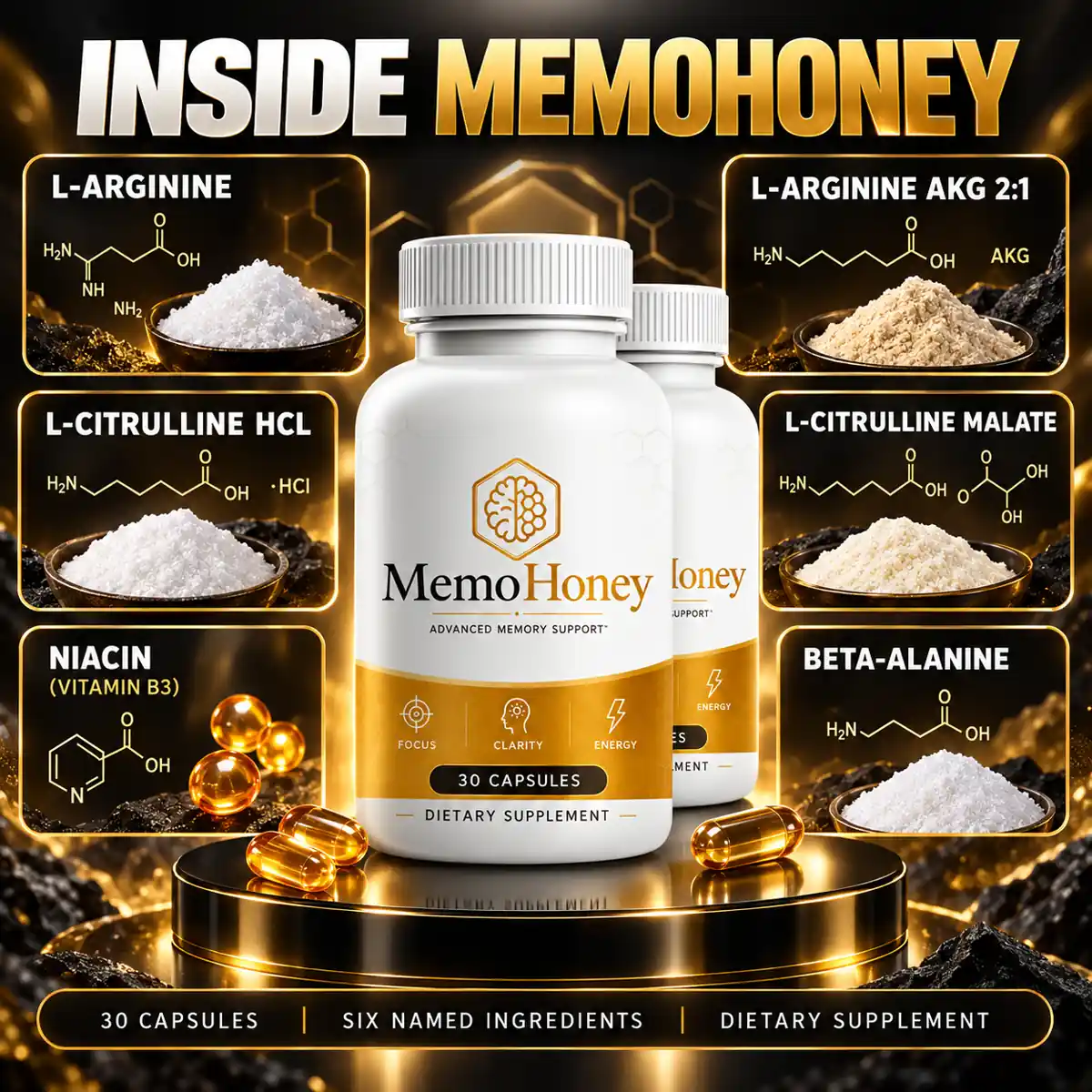
What niacin actually does in a cell
Vitamin B3 is converted into nicotinamide adenine dinucleotide, NAD, and its phosphorylated form NADP. Those two molecules are electron carriers, and they turn up in glycolysis, in the Krebs cycle, in fatty acid synthesis, and in a long list of repair enzymes that depend on NAD as a substrate rather than a cofactor.
Without enough NAD a cell cannot turn food into usable energy at all. Read that way the word printed across a supplement band is chemically exact and commercially useless: it names electron transfer, not a lift. Niacin is not a stimulant.
The brain is a heavy consumer of energy for its weight, so a cofactor in energy metabolism has an obvious route to mattering there. The question, as always, is whether adding more to a system that already has enough does anything.
The deficiency link, which is real
Severe niacin deficiency produces pellagra, and the classical medical description of pellagra lists four Ds: dermatitis, diarrhoea, dementia and death. The dementia in that list is not a metaphor. It is a genuine cognitive syndrome that reverses on treatment.
It is also not confined to history. Case reports still appear in the literature, generally in the context of malnutrition, alcohol use disorder, malabsorption or restrictive eating.
So the connection between niacin and cognition is established at one end of the dose range: take enough away and thinking fails. What that does not establish is anything about the other direction. Scurvy proves vitamin C is essential; it does not make vitamin C a treatment for anything in a person who already eats fruit.
- Severe niacin shortage causes a reversible dementia, as part of pellagra.
- Correcting a shortage restores function that was lost.
- Adding more to a sufficient intake is a completely different proposition.
- No trial has shown niacin supplementation improves memory in well-nourished adults.
The cohort study everyone cites
There is one study that turns up behind almost every niacin-and-memory claim, and it is worth reading properly rather than repeating.
A prospective study in a geographically defined Chicago community followed 6,158 residents aged 65 and over between 1993 and 2002. Nutrient intake was determined by food frequency questionnaire. Cognitive tests were given at three-year intervals across a six-year follow-up, and 3,718 participants had both dietary data and at least two assessments.
Energy-adjusted niacin intake was associated with a lower rate of incident Alzheimer's disease and with slower cognitive decline over a median 5.5 years.
That is a genuinely interesting finding and it is an observational one. It measured what people ate, not what they supplemented. People with higher dietary niacin eat more meat, fish, poultry and fortified grain, which travels with a broader diet and with a set of social and economic factors that are hard to separate from the nutrient. Cohort studies establish association, and this one is honest about being one.
What it does not do is establish that adding a niacin capsule to an adequate diet reproduces the result. This website cites it as a dietary cohort and describes it as such every time it appears.
Niacin is the most defensible name on the MemoHoney label
It works in milligrams, which means a capsule can genuinely carry a useful amount of it. Sixty days to decide whether the rest of the formula earns its place beside it.
Two bottles $158 · six bottles $294 · 60-day money-back guarantee
Order MemoHoney On The Official WebsiteOne capsule a day · 30 per bottle · lot MEM-26/ME-3415
What happens at gram doses
The other half of the niacin literature is about amounts forty to sixty times a nutritional intake, and it is uniformly negative. It is worth knowing precisely because it is the part most likely to be quoted out of context in either direction.
| Context | Amount | What happens there |
|---|---|---|
| Ordinary diet | Milligrams a day | Sufficiency. NAD and NADP are made normally |
| Severe shortage | Far below that | Pellagra, whose classical description includes dementia |
| The Chicago cohort's higher intakes | Dietary, by questionnaire | Associated with less cognitive decline over a median 5.5 years |
| AIM-HIGH | 1.5 to 2 g a day, extended release | No reduction in cardiovascular events alongside statins |
| HPS2-THRIVE | 2 g a day with laropiprant | No reduction in vascular events, with an excess of serious adverse events |
Five contexts across four orders of magnitude. Conflating any two of them produces a false statement about niacin.
AIM-HIGH gave extended-release niacin at 1.5 to 2 g a day to patients with low HDL cholesterol who were already on intensive statin therapy, and found no reduction in cardiovascular events. HPS2-THRIVE gave 2 g of extended-release niacin with laropiprant to more than 25,000 high-risk patients and found no reduction in vascular events alongside an excess of serious adverse events. The AIM-HIGH safety report set out the adverse-event profile in detail.
Those trials ended niacin's career as a lipid drug. They say nothing about a capsule carrying a nutritional amount, and citing them as a safety warning about a supplement would be the same error in reverse as citing the Chicago cohort as proof a capsule works. Dose is the whole subject.
Three forms, and why a label should say which
| Form | Also called | Flushing | Used for |
|---|---|---|---|
| Nicotinic acid | Niacin | Yes, through prostaglandin D2 release | Lipid modification at gram doses; nutrition at milligram doses |
| Niacinamide | Nicotinamide | No | Nutrition, and dermatology at higher amounts |
| Inositol hexanicotinate | No-flush niacin | Little to none | Marketed as a flush-free alternative |
A label that says only Niacin (Vitamin B3), as this one does, has not told you which of these is in the capsule.
The practical difference between these is the flush. Nicotinic acid produces a warm, prickling redness across the face, neck and upper chest within fifteen to thirty minutes, through a prostaglandin D2 mechanism reviewed in detail here. It is harmless, it fades within the hour, and it becomes less pronounced with continued daily use over one to two weeks.
Niacinamide does not do it at all. So a label that prints only Niacin (Vitamin B3), as this one does, leaves a buyer unable to predict the most noticeable thing that might happen on their first morning.
There is a silver lining, and on a label with no panel it is worth taking. If you do flush, you have learned two facts the label did not give you: the form is nicotinic acid, and the amount is not trivial. Write down the day and how long it lasted. The side effects page covers what to do about it, which is mostly nothing.
Adding up your own intake
This is the one practical consequence of the missing panel that applies to niacin specifically, and it is worth five minutes.
- Breakfast cereal. Fortified cereals are a substantial niacin source and the box prints the amount.
- A multivitamin. Almost all of them contain niacin, and the panel states how much.
- A B-complex. These carry considerably more than a multivitamin, often many times an ordinary daily intake.
- An energy drink. Many are heavily fortified with B vitamins including niacin.
- This capsule. Unknown, because the label prints no figure.
The honest position is that you cannot total it exactly while one of the five lines is blank. What you can do is know the other four, which is the next best thing and takes one reading of four labels you already own.
If you flush on the first morning and you also take a B-complex, that is a combination worth mentioning to a pharmacist or a doctor. Not because it is dangerous at these amounts, but because it is the kind of thing that is easy to establish and pointless to guess at.
It is the most defensible of the six names, and the reason is dose. Five of the other ingredients were researched at gram amounts a capsule cannot hold. Niacin works in milligrams, so this is the one row where a capsule can plausibly carry a useful amount. That is worth saying as clearly as the criticism.
None of that makes niacin a memory ingredient. It makes it the one row on this label where the missing panel costs a reader the least, because the plausible range is narrow and the consequences at either end of it are well understood. On the five gram-scale rows the same omission hides the difference between a meaningful dose and a token one, and that is a far larger gap to be left guessing about.
So if you are weighing this formula, weigh it as five open questions and one reasonable answer. The ingredients page lays all six out in order with the trial dose beside each, which is the closest a reader can get to the panel that is not there.
MemoHoney is a dietary supplement for healthy adults of 18 and over. It is not a medicine, it is not FDA-approved, and it is not intended to diagnose, treat, cure or prevent any disease. Memory that is getting worse month by month, or that family notice before you do, deserves an assessment: thyroid function, vitamin B12, depression, sleep apnoea, hearing loss and several common medicines all produce the same symptom and all have a route to treatment that a capsule does not.
References
- From J Neurol Neurosurg Psychiatry (2004): Dietary niacin and the risk of incident Alzheimer's disease and of cognitive decline, by Morris with co-authors; PubMed ID 15258207. https://pubmed.ncbi.nlm.nih.gov/15258207/
- From Front Med (Lausanne) (2024): Case report: Pellagra presentation with dermatitis and dysphagia, by Mengistu with co-authors; PubMed ID 39045418. https://pubmed.ncbi.nlm.nih.gov/39045418/
- From Int J Clin Pract (2009): The mechanism and mitigation of niacin-induced flushing, by Kamanna with co-authors; PubMed ID 19691622. https://pubmed.ncbi.nlm.nih.gov/19691622/
- From N Engl J Med (2014): Effects of extended-release niacin with laropiprant in high-risk patients, by the HPS2-THRIVE Collaborative Group; PubMed ID 25014686. https://pubmed.ncbi.nlm.nih.gov/25014686/
- From N Engl J Med (2011): Niacin in patients with low HDL cholesterol levels receiving intensive statin therapy, by AIM-HIGH Investigators with co-authors; PubMed ID 22085343. https://pubmed.ncbi.nlm.nih.gov/22085343/
- From N Engl J Med (2014): Safety profile of extended-release niacin in the AIM-HIGH trial, by Anderson with co-authors; PubMed ID 25014706. https://pubmed.ncbi.nlm.nih.gov/25014706/