MemoHoney Official Website › Ingredients
IngredientsMemoHoney ingredients: all six named actives on the label
Six actives, printed on the bottle and repeated on the seller's own ingredient graphic.
Two forms of citrulline, two of arginine, niacin and beta-alanine. The artwork carries no Supplement Facts panel, so no amount is printed for any of them. Beside each name below is the amount that ingredient's own published trials used.
The two lists agree name for name, which is less common in this category than it should be. What neither list carries is a number.
The six actives on the MemoHoney label, in label order
L-Arginine
Trials used 9 g/dayNitric oxide synthase has one raw material and this is it. Arginine is conditionally essential, meaning the body makes some and wants more under load, and that is why it appears on every label in this aisle.
Getting it there is the difficulty. Arginase waits in the gut wall and again in the liver, and a good share of any swallowed dose is taken apart before it reaches the blood. Hence citrulline on the same label, and hence trials that reach for whole grams.
The largest and most sobering of those is the VINTAGE MI trial, which gave 3 g three times a day for six months to people recovering from a heart attack and was stopped early. A 2018 systematic review and meta-analysis found arginine supplementation associated with improvements in markers of endothelial function, again in people with existing cardiovascular or metabolic disease.
On cognition specifically the record is thinner and it is about different molecules. A 2021 randomised trial used inositol-stabilised arginine silicate, a patented complex, and reported acute cognitive outcomes in healthy adults. A four-week study gave twenty healthy volunteers homoarginine, a related but distinct amino acid. Neither tested the plain L-arginine on this label.
L-Arginine AKG 2:1 Extract
Trials used 12 g/dayArginine bound to alpha-ketoglutarate in a two-to-one ratio. The rationale is that alpha-ketoglutarate is itself a Krebs cycle intermediate, so the salt is sold as delivering two useful things at once.
the AAKG pharmacokinetic trial is the study that characterised it: trained adult men, 4 g of AAKG three times a day for a total of 12 g, with pharmacokinetics, safety and exercise performance as the endpoints. It is a sports-nutrition paper from a sports-nutrition journal, and it is the main human record this ingredient has.
No trial has tested arginine alpha-ketoglutarate on memory, attention or any cognitive endpoint in any population. That sentence is here because its absence elsewhere is how a reader ends up assuming otherwise.
L-Citrulline HCl
Trials used 0.75 to 6 gCitrulline as a hydrochloride salt, which is simply a stable, water-soluble way to deliver citrulline.
the citrulline dose-ranging study is the study that explains why this ingredient belongs on the label. It ran a dose ladder of oral citrulline and oral arginine in healthy volunteers and measured what each did to plasma arginine and to nitric oxide metabolism. Citrulline raised plasma arginine more effectively than arginine did, and the rise tracked the dose across the ladder.
That is a genuinely useful finding and it is the strongest piece of mechanistic reasoning behind this formula. What it measured was plasma chemistry, not thinking.
L-Citrulline Malate
Trials used 8 gCitrulline paired with malic acid, and the form the pre-workout aisle made famous.
the citrulline malate bench-press trial gave 8 g before a bench-press session and reported more repetitions and less soreness. A 2024 trial tested three days of citrulline malate on repeated sprint running in team sport athletes. A taekwondo study combined branched-chain amino acids, arginine and citrulline and looked at central fatigue across three simulated matches, which is the closest this ingredient gets to a cognitive endpoint, and it is a fatigue measure rather than a memory one.
In older adults, a chronic nitrate and citrulline trial looked at vascular function and exercise performance, and a companion study paired nitric oxide precursors with training. The pattern across all of them is consistent: the endpoints are vascular and athletic.
Niacin (Vitamin B3)
Food intakes are milligrams a dayOf the six, this is the one a researcher has actually studied against and the only one whose useful dose is measured in milligrams rather than grams. That distinction matters more than anything else on this page: a capsule can hold a nutritionally meaningful amount of niacin without difficulty.
Niacin becomes NAD and NADP, the two cofactors that carry electrons in almost every energy-handling reaction in a cell. A severe shortage produces pellagra, whose classical description includes dementia, and cases still appear in the literature.
A prospective study of 6,158 Chicago residents aged 65 and over found that higher dietary niacin intake was associated with a lower rate of incident Alzheimer's disease and with slower cognitive decline over a median 5.5 years of follow-up. That was food intake measured by questionnaire in an observational cohort. It is genuinely interesting and it is not a supplement trial.
At the other end of the dose range the story reverses. AIM-HIGH and HPS2-THRIVE both gave extended-release niacin at gram doses alongside statins and both failed to reduce cardiovascular events, with the AIM-HIGH safety report documenting the adverse-event profile. Those are pharmacological doses, forty to sixty times a nutritional amount, and nothing about them describes a capsule.
Beta-Alanine
Trials used 4 to 6 g/dayNothing in the body uses beta-alanine as beta-alanine. It is one half of carnosine, and every gram of it on a label is there to raise the amount of carnosine banked in tissue over the following weeks.
The ISSN position stand sets the practical range at 4 to 6 grams a day for a minimum of four weeks, notes that paraesthesia is the characteristic side effect, and recommends divided doses or a sustained-release form to manage it. The loading literature and a 2017 meta-analysis of 40 studies describe what that buys, which is a modest benefit in high-intensity exercise lasting 30 seconds to 10 minutes. An individual-participant-data meta-analysis went further and found no evidence that some people respond and others do not.
The cognitive record is two-sided and both sides belong here. the combat-soldier trial gave twenty elite combat soldiers beta-alanine for 28 days and found no difference on a serial-subtraction task, while the same soldiers did shoot more accurately. In older adults, a double-blind trial at 2.4 g a day for twelve weeks reported effects on cognitive function, mood and physical function, and a 2024 diffusion-imaging follow-up reported changes in hippocampal and amygdala fractional anisotropy.
One more distinction is worth stating plainly. The trials that found memory effects in this family gave people carnosine or anserine directly: the anserine and carnosine memory trial used 1.0 g a day of an anserine and carnosine formula in a three-to-one ratio for three months, with a follow-up in APOE4 carriers and the NEAT trial behind it. Beta-alanine is the precursor, which is a slower and less direct route to the same molecule.
What the MemoHoney label does not print
The artwork names the six and stops. There is no Supplement Facts panel, no serving-size line and no percentage of any daily value, so a reader has nothing to compare with the doses above.
Read that table in one direction only. The right-hand column is what the published research used; the middle column is what the bottle offers to set against it, which is nothing. Nobody can say from this label whether the capsule holds a tenth of those amounts or a hundredth.
The fair counterweight is that five of these six are commodity amino acids with a long history of safe use, and a formula can be designed as a daily nudge rather than a clinical dose. Niacin in particular does real work at milligram amounts. What no reader can do is verify which design this is.
What is not in MemoHoney
A formula is partly defined by what it leaves out, and this one leaves out every ingredient the memory category is usually built from.
| Commonly expected | Present here | Why it matters |
|---|---|---|
| Bacopa monnieri | No | The botanical with the best memory trial record, usually over 12 weeks |
| Ginkgo biloba | No | Pictured in the seller's own hero photograph, absent from the formula |
| Citicoline or alpha-GPC | No | The cholinergic route, which is the other main approach in this category |
| Huperzine A | No | A cholinesterase inhibitor, and a reason to be glad |
| Omega-3 (DHA) | No | The structural fat the brain is largely built from |
| Caffeine or any stimulant | No | Nothing here produces a same-day effect to feel |
| Vitamin B12 or folate | No | The two nutrients most worth checking in unexplained forgetfulness |
None of these absences is a fault. They define what this formula is: a blood-flow product with one vitamin, rather than a cholinergic or botanical one.
Ginkgo deserves its own sentence. It appears in the seller's own hero photograph, stood behind the bottle alongside rosemary and blueberries, and it is not in the capsule. That is stock photography for the category rather than a picture of the contents, and a reader who buys on the strength of the leaf will be disappointed by the list.
How the MemoHoney ingredient list compares with a proprietary blend
There is a version of this criticism that this label does not deserve, and separating the two is worth doing.
A proprietary blend prints a single combined weight and hides the split. A buyer who sees 850 mg of a Cognitive Support Matrix cannot tell whether that is 800 mg of the cheap ingredient and 10 mg each of the five expensive ones. That construction is designed to be unreadable.
This label does something different. It names all six, in order, with nothing hidden behind a trademark, and the seller's own graphic repeats the same six. What is missing is the panel itself, which is a different failure and, in regulatory terms, a stranger one.
So the fair summary is that the list is honest and the quantification is absent. A blend hides the split on purpose. This bottle simply does not print it, and the fix is one panel.
- Six names, in order, with no trademarked blend wrapper around them.
- The ingredient graphic and the written list agree exactly. Mismatches between those two are common in this category.
- A caution that names three specific medicine classes rather than saying consult a professional and leaving it there.
How this MemoHoney ingredient review was written
- Schulman SP, Becker LC, Kass DA, et al. L-arginine therapy in acute myocardial infarction: the Vascular Interaction With Age in Myocardial Infarction (VINTAGE MI) randomized clinical trial. JAMA. 2006;295(1):58-64. PMID 16391217. https://pubmed.ncbi.nlm.nih.gov/16391217/
- Rodrigues-Krause J, Krause M, Rocha IMGD, et al. Association of l-Arginine Supplementation with Markers of Endothelial Function in Patients with Cardiovascular or Metabolic Disorders: A Systematic Review and Meta-analysis. Nutrients. 2018;11(1):15. PMID 30577559. https://pubmed.ncbi.nlm.nih.gov/30577559/
- Gills JL, Campitelli A, Jones M, et al. Acute Inositol-Stabilized Arginine Silicate Improves Cognitive Outcomes in Healthy Adults. Nutrients. 2021;13(12):4272. PMID 34959823. https://pubmed.ncbi.nlm.nih.gov/34959823/
- Schönhoff M, Weineck G, Hoppe J, et al. Cognitive performance of 20 healthy humans supplemented with L-homoarginine for 4 weeks. J Clin Neurosci. 2018;50:237-241. PMID 29396070. https://pubmed.ncbi.nlm.nih.gov/29396070/
- Campbell B, Roberts M, Kerksick C, et al. Pharmacokinetics, safety, and effects on exercise performance of L-arginine alpha-ketoglutarate in trained adult men. Nutrition. 2006;22(9):872-81. PMID 16928472. https://pubmed.ncbi.nlm.nih.gov/16928472/
- Schwedhelm E, Maas R, Freese R, et al. Pharmacokinetic and pharmacodynamic properties of oral L-citrulline and L-arginine: impact on nitric oxide metabolism. Br J Clin Pharmacol. 2008;65(1):51-9. PMID 17662090. https://pubmed.ncbi.nlm.nih.gov/17662090/
- Pérez-Guisado J, Jakeman PM. Citrulline malate enhances athletic anaerobic performance and relieves muscle soreness. J Strength Cond Res. 2010;24(5):1215-22. PMID 20386132. https://pubmed.ncbi.nlm.nih.gov/20386132/
- Faria VS, Egan B. Effects of 3 days of citrulline malate supplementation on short-duration repeated sprint running performance in male team sport athletes. Eur J Sport Sci. 2024;24(6):758-765. PMID 38874989. https://pubmed.ncbi.nlm.nih.gov/38874989/
- Chen IF, Wu HJ, Chen CY, et al. Branched-chain amino acids, arginine, citrulline alleviate central fatigue after 3 simulated matches in taekwondo athletes: a randomized controlled trial. J Int Soc Sports Nutr. 2016;13:28. PMID 27418883. https://pubmed.ncbi.nlm.nih.gov/27418883/
- Le Roux-Mallouf T, Pelen F, Vallejo A, et al. Effect of chronic nitrate and citrulline supplementation on vascular function and exercise performance in older individuals. Aging (Albany NY). 2019;11(10):3315-3332. PMID 31141497. https://pubmed.ncbi.nlm.nih.gov/31141497/
- Le Roux-Mallouf T, Vallejo A, Pelen F, et al. Synergetic Effect of NO Precursor Supplementation and Exercise Training. Med Sci Sports Exerc. 2020;52(11):2437-2447. PMID 33064413. https://pubmed.ncbi.nlm.nih.gov/33064413/
- Morris MC, Evans DA, Bienias JL, et al. Dietary niacin and the risk of incident Alzheimer's disease and of cognitive decline. J Neurol Neurosurg Psychiatry. 2004;75(8):1093-9. PMID 15258207. https://pubmed.ncbi.nlm.nih.gov/15258207/
- Mengistu SB, Ali I, Alemu H, et al. Case report: Pellagra presentation with dermatitis and dysphagia. Front Med (Lausanne). 2024;11:1390180. PMID 39045418. https://pubmed.ncbi.nlm.nih.gov/39045418/
- AIM-HIGH Investigators, Boden WE, Probstfield JL, et al. Niacin in patients with low HDL cholesterol levels receiving intensive statin therapy. N Engl J Med. 2011;365(24):2255-67. PMID 22085343. https://pubmed.ncbi.nlm.nih.gov/22085343/
- HPS2-THRIVE Collaborative Group, Landray MJ, Haynes R, et al. Effects of extended-release niacin with laropiprant in high-risk patients. N Engl J Med. 2014;371(3):203-12. PMID 25014686. https://pubmed.ncbi.nlm.nih.gov/25014686/
- Anderson TJ, Boden WE, Desvigne-Nickens P, et al. Safety profile of extended-release niacin in the AIM-HIGH trial. N Engl J Med. 2014;371(3):288-90. PMID 25014706. https://pubmed.ncbi.nlm.nih.gov/25014706/
- Trexler ET, Smith-Ryan AE, Stout JR, et al. International society of sports nutrition position stand: Beta-Alanine. J Int Soc Sports Nutr. 2015;12:30. PMID 26175657. https://pubmed.ncbi.nlm.nih.gov/26175657/
- Hoffman JR, Landau G, Stout JR, et al. β-alanine supplementation improves tactical performance but not cognitive function in combat soldiers. J Int Soc Sports Nutr. 2014;11(1):15. PMID 24716994. https://pubmed.ncbi.nlm.nih.gov/24716994/
- Ostfeld I, Ben-Zeev T, Zamir A, et al. Role of β-Alanine Supplementation on Cognitive Function, Mood, and Physical Function in Older Adults; Double-Blind Randomized Controlled Study. Nutrients. 2023;15(4):923. PMID 36839281. https://pubmed.ncbi.nlm.nih.gov/36839281/
- Ostfeld I, Zamir A, Ben-Zeev T, et al. β-Alanine supplementation improves fractional anisotropy scores in the hippocampus and amygdala in 60-80-year-old men and women. Exp Gerontol. 2024;194:112513. PMID 38971131. https://pubmed.ncbi.nlm.nih.gov/38971131/
- Saunders B, Elliott-Sale K, Artioli GG, et al. β-alanine supplementation to improve exercise capacity and performance: a systematic review and meta-analysis. Br J Sports Med. 2017;51(8):658-669. PMID 27797728. https://pubmed.ncbi.nlm.nih.gov/27797728/
- Artioli GG, Gualano B, Smith A, et al. Role of beta-alanine supplementation on muscle carnosine and exercise performance. Med Sci Sports Exerc. 2010;42(6):1162-73. PMID 20479615. https://pubmed.ncbi.nlm.nih.gov/20479615/
- Esteves GP, Swinton P, Sale C, et al. Individual Participant Data Meta-Analysis Provides No Evidence of Intervention Response Variation in Individuals Supplementing With Beta-Alanine. Int J Sport Nutr Exerc Metab. 2021;31(4):305-313. PMID 34098531. https://pubmed.ncbi.nlm.nih.gov/34098531/
- Hisatsune T, Kaneko J, Kurashige H, et al. Effect of Anserine/Carnosine Supplementation on Verbal Episodic Memory in Elderly People. J Alzheimers Dis. 2016;50(1):149-59. PMID 26682691. https://pubmed.ncbi.nlm.nih.gov/26682691/
- Masuoka N, Yoshimine C, Hori M, et al. Effects of Anserine/Carnosine Supplementation on Mild Cognitive Impairment with APOE4. Nutrients. 2019;11(7):1626. PMID 31319510. https://pubmed.ncbi.nlm.nih.gov/31319510/
- O'Toole TE, Amraotkar AR, Gao H, et al. Carnosine supplementation improves cognitive outcomes in younger participants of the NEAT trial. Neurotherapeutics. 2025;22(2):e00541. PMID 39919936. https://pubmed.ncbi.nlm.nih.gov/39919936/
MemoHoney ingredients: questions buyers ask
How many ingredients does MemoHoney have?
Six named actives. The bottle graphic and the seller's own ingredient list agree exactly: L-Arginine, L-Arginine AKG 2:1 Extract, L-Citrulline HCl, L-Citrulline Malate, Niacin (Vitamin B3) and Beta-Alanine.
Why does MemoHoney contain both arginine and citrulline?
They feed one pathway from two directions. Swallowed arginine is largely broken down before it reaches circulation; citrulline survives that first pass and the kidney converts it back into arginine. Pairing them is standard practice in this ingredient family rather than a choice specific to this label.
Is there caffeine in MemoHoney?
No. Nothing on the label is a stimulant. The word Energy on the band refers to niacin's role as a cofactor in energy metabolism.
Does MemoHoney list the amount of each ingredient?
No. The artwork carries no Supplement Facts panel, so there is no figure beside any of the six names. This page prints the amount each ingredient's own research used so a reader has one side of the comparison.
Are the MemoHoney ingredients vegetarian?
All six actives are produced by fermentation or synthesis rather than from animal tissue, and the pack ships a vegetarian-friendly badge. The label does not state what the capsule shell is made from, which is the part that would decide it.
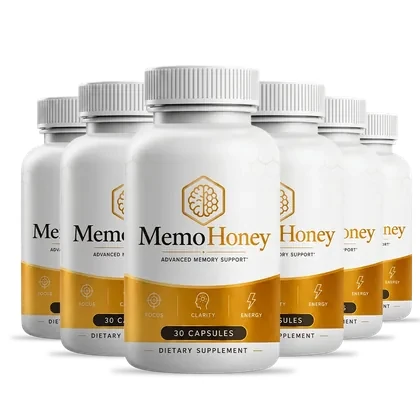
Six names you can look up, then buy MemoHoney
Six names, no proprietary blend, and the dose each one's own research used printed above. Sixty days to decide whether the capsule earns its place.
Two bottles $158 · six bottles $294 · 60-day money-back guarantee
Order MemoHoney On The Official WebsiteOne capsule a day · 30 per bottle · lot MEM-26/ME-3415