MemoHoney Official Website › Side Effects
Side EffectsMemoHoney side effects and interactions, ingredient by ingredient
Two effects are predictable from this ingredient list: a niacin flush and beta-alanine tingling.
Both are harmless and both are dose-related, so their presence or absence is information about the capsule rather than a fault in it. The interactions that matter are the three the seller names: blood pressure medicine, blood thinners and vasodilators.
No adverse event data exists for this formula, because no trial of this formula exists. What follows is the record for each ingredient separately.
The two MemoHoney effects you might actually notice
Niacin flush
A warm, prickling redness across the face, neck and upper chest, usually within fifteen to thirty minutes and gone within an hour. It is caused by prostaglandin D2 release in the skin, a mechanism reviewed in detail here, and it is harmless.
Only nicotinic acid does this. Niacinamide, the other common form, does not. The label does not say which form is in the capsule, so a flush on the first morning tells you two things at once: the form is nicotinic acid, and the amount is not trivial.
It fades with repeated daily use over one to two weeks. Taking the capsule with food reduces it, at the cost of the empty-stomach timing the label asks for.
Beta-alanine paraesthesia
Pins and needles across the face, scalp, neck and hands, starting around fifteen minutes in and fading within an hour. The ISSN position stand describes it as the characteristic side effect of beta-alanine, harmless, and dose-related.
It generally needs a single dose somewhere around 800 mg to appear, which is a large fraction of what a capsule this size can hold. So its absence is not evidence of anything either way, and its presence would be the most informative thing this label could tell a buyer.
The three interactions the MemoHoney seller names
The caution printed on the seller's own information page is quoted below and then taken apart, because it is better labelling than most of this category manages and it deserves to be read rather than skimmed.
“If you are pregnant, nursing, under the age of 18, or have a known medical condition — especially if you take medications for blood pressure, blood thinners, or vasodilators — we recommend showing the label to your doctor before starting.”
| Named | Why it is named | What it means in practice |
|---|---|---|
| Blood pressure medicine | Five of the six actives feed nitric oxide, which relaxes vessel walls. A watermelon extract trial measured a reduction in prehypertensive and hypertensive subjects. | Additive with anything already lowering blood pressure. Show the bottle to the prescriber and ask whether to watch readings for a fortnight. |
| Blood thinners | Nitric oxide affects platelet aggregation. No trial has measured this combination with an anticoagulant. | Mechanistically plausible rather than documented. It is still the right conversation to have before starting. |
| Vasodilators | These act on the same pathway from the other direction, so the overlap is the most direct of the three. | The interaction with the clearest rationale on this list. |
This table is about mechanism, not about measured events. No trial has tested these six ingredients alongside any medicine.
What the wider literature says about the MemoHoney ingredient family
Three findings are worth knowing and none of them describes a capsule at an ordinary supplement dose. They are here because the honest way to discuss safety is to name the strongest signals and then say where they came from.
the VINTAGE MI trial randomised people recovering from a heart attack to 3 g of L-arginine three times a day or placebo for six months. The trial was stopped early: six participants in the arginine arm died and none in the placebo arm. That is 9 g a day in a fragile cardiac population, and it is the single reason the dose question in this category is worth taking seriously.
HPS2-THRIVE gave 2 g of extended-release niacin with laropiprant to more than 25,000 high-risk patients on statins and found no reduction in vascular events alongside an excess of serious adverse events. AIM-HIGH reached the same conclusion at 1.5 to 2 g, and the safety report set out the profile. Those doses are forty to sixty times a nutritional amount of niacin.
Animal work on beta-alanine has raised a theoretical question about taurine, because the two share a transporter. It has not been shown to matter in humans at supplement doses.
None of the three describes this product. All three describe what happens when an ingredient on this label is pushed to a pharmacological dose, and that is exactly the context a reader needs when the label prints no amount at all.
Practical MemoHoney safety, in plain terms
- Take one capsule. The label says not to exceed the stated dose, and there is no published reason to think two would do more.
- A flush or a tingle in the first fortnight is expected chemistry, not harm. Write down which one and on which day.
- Persistent stomach discomfort usually answers to taking the capsule with the first meal instead of before it.
- Stop and speak to a clinician about anything that is new, persistent and unexplained. That is ordinary advice for any supplement.
- Supplements are not risk-free as a class: a national survey estimated about 23,000 emergency department visits a year in the United States attributed to them.
- Keep the bottle. If something does go wrong, the lot number on the base is the first thing anyone will ask for.
How this MemoHoney safety page was written
- Kamanna VS, Ganji SH, Kashyap ML. The mechanism and mitigation of niacin-induced flushing. Int J Clin Pract. 2009;63(9):1369-77. PMID 19691622. https://pubmed.ncbi.nlm.nih.gov/19691622/
- HPS2-THRIVE Collaborative Group, Landray MJ, Haynes R, et al. Effects of extended-release niacin with laropiprant in high-risk patients. N Engl J Med. 2014;371(3):203-12. PMID 25014686. https://pubmed.ncbi.nlm.nih.gov/25014686/
- AIM-HIGH Investigators, Boden WE, Probstfield JL, et al. Niacin in patients with low HDL cholesterol levels receiving intensive statin therapy. N Engl J Med. 2011;365(24):2255-67. PMID 22085343. https://pubmed.ncbi.nlm.nih.gov/22085343/
- Anderson TJ, Boden WE, Desvigne-Nickens P, et al. Safety profile of extended-release niacin in the AIM-HIGH trial. N Engl J Med. 2014;371(3):288-90. PMID 25014706. https://pubmed.ncbi.nlm.nih.gov/25014706/
- Trexler ET, Smith-Ryan AE, Stout JR, et al. International society of sports nutrition position stand: Beta-Alanine. J Int Soc Sports Nutr. 2015;12:30. PMID 26175657. https://pubmed.ncbi.nlm.nih.gov/26175657/
- Jong CJ, Ito T, Mozaffari M, et al. Effect of beta-alanine treatment on mitochondrial taurine level and 5-taurinomethyluridine content. J Biomed Sci. 2010;17 Suppl 1:S25. PMID 20804600. https://pubmed.ncbi.nlm.nih.gov/20804600/
- Schulman SP, Becker LC, Kass DA, et al. L-arginine therapy in acute myocardial infarction: the Vascular Interaction With Age in Myocardial Infarction (VINTAGE MI) randomized clinical trial. JAMA. 2006;295(1):58-64. PMID 16391217. https://pubmed.ncbi.nlm.nih.gov/16391217/
- Massa NM, Silva AS, Toscano LT, et al. Watermelon extract reduces blood pressure but does not change sympathovagal balance in prehypertensive and hypertensive subjects. Blood Press. 2016;25(4):244-8. PMID 26947668. https://pubmed.ncbi.nlm.nih.gov/26947668/
- Geller AI, Shehab N, Weidle NJ, et al. Emergency Department Visits for Adverse Events Related to Dietary Supplements. N Engl J Med. 2015;373(16):1531-40. PMID 26465986. https://pubmed.ncbi.nlm.nih.gov/26465986/
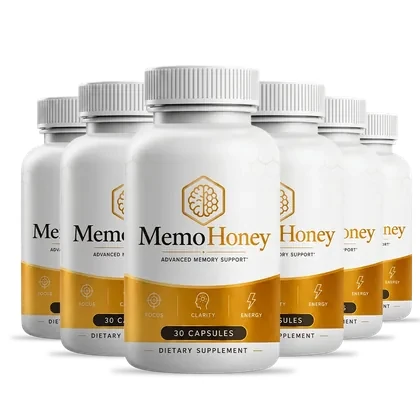
Order MemoHoney with the safety picture in front of you
Two predictable effects, three named interactions and a sixty-day window if it does not suit you.
Two bottles $158 · six bottles $294 · 60-day money-back guarantee
Order MemoHoney On The Official WebsiteOne capsule a day · 30 per bottle · lot MEM-26/ME-3415