MemoHoney Official Website › Blog › No Supplement Facts Panel
What It Means When A Label Has No Supplement Facts Panel
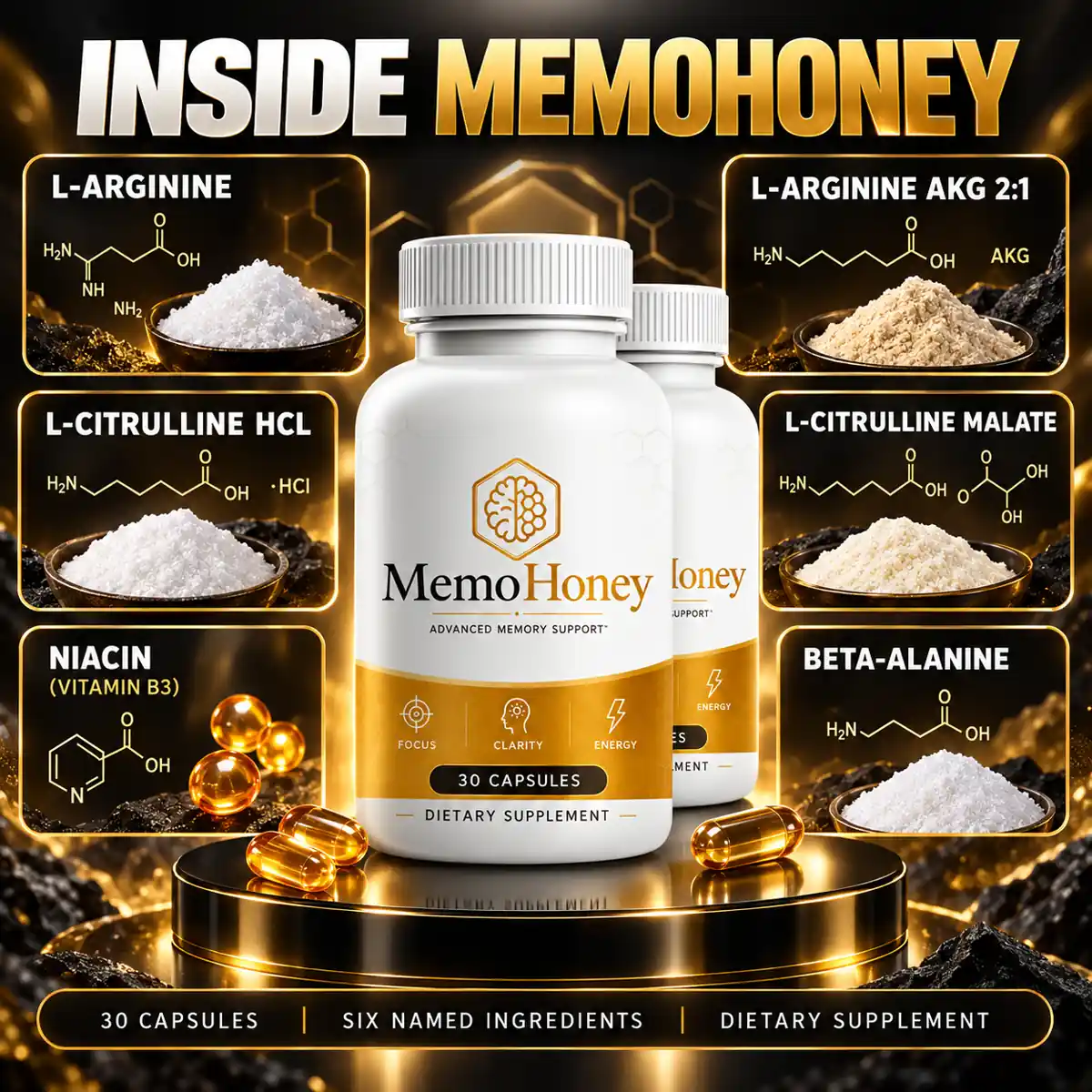
Six ingredients named in order, with nothing hidden behind a trademarked blend, and no milligram figure anywhere on the artwork. That combination is unusual, and it is the single most important thing to understand about this product before buying it.
What a Supplement Facts panel is for
A Supplement Facts panel is the black-ruled box on the back of a supplement bottle. It states the serving size, the number of servings in the container, every dietary ingredient with the amount per serving, and a percentage of daily value wherever one has been established. Underneath it sits the other-ingredients line, which is where the capsule shell, the flow agents and the fillers are declared.
It exists so a buyer can do three things: compare what is in the bottle with what a published study used, compare two products against each other, and add up an intake across everything they take. None of those is possible without it.
The FDA publishes its own questions and answers on what supplement labelling has to carry, and the FTC sets out what substantiation a health claim needs. Between them they describe a system in which the panel is the load-bearing element, because it is the part that is checkable.
What this bottle carries instead
Six names, in order, on the front graphic and in the seller's written list. No panel, no serving weight, no percentage of any daily value, and no other-ingredients line. The capsule count is printed, thirty, and the serving is one a day, so the servings arithmetic is answerable. The composition is not.
Three ways a label can be unreadable
| Label problem | What it looks like | How bad |
|---|---|---|
| A proprietary blend | One combined weight, the split hidden | Deliberately unreadable. The worst of the three |
| No panel at all | Names listed, no weights anywhere | Unreadable by omission. Stranger, because a panel is expected |
| A panel with small amounts | Every weight printed, several far under trial doses | The most honest of the three: you can at least argue with it |
Counter-intuitively, the third row is the best label to buy from, because it is the only one where a buyer can do the arithmetic.
The ranking in the right-hand column surprises people, so it is worth defending.
A proprietary blend is the worst because it is a deliberate construction. Somebody chose to print 850 mg of a Cognitive Support Matrix rather than six weights, and the only reason to make that choice is to prevent the reader from seeing the split. It is unreadability as a design goal.
No panel at all is second, and it is stranger rather than more cynical. It withholds the same information without the construction, and in the United States it is not what a packaged supplement is expected to carry. Whatever the explanation is, the effect on a buyer is identical to the blend.
A panel full of small amounts is the best of the three, which sounds wrong until you think about it. A label printing 50 mg of an ingredient whose trials used 500 mg is telling you the truth about a disappointing formula. You can check it, argue with it and decide. That is what a label is for.
The arithmetic a Supplement Facts panel would allow
Here is what a reader would do with a panel on this particular product, and cannot.
| Ingredient | What this label prints | What its own trials used |
|---|---|---|
| L-Arginine | The name | 9 g a day, as 3 g three times daily |
| L-Arginine AKG 2:1 | The name | 12 g a day, as 4 g three times daily |
| L-Citrulline HCl | The name | 0.75 to 6 g in the dose-ranging study |
| L-Citrulline Malate | The name | 8 g in a single pre-exercise dose |
| Niacin (Vitamin B3) | The name | Milligrams a day from food |
| Beta-Alanine | The name | 4 to 6 g a day for four weeks minimum |
The middle column is the same on every row, which is the whole point of this article.
Five of those six ingredients were researched at gram doses. The arginine alpha-ketoglutarate study used 12 g a day. The citrulline malate trial used 8 g in a single dose. The ISSN position stand on beta-alanine sets 4 to 6 g a day as the working range. The citrulline dose-ranging study went up to 6 g.
A hard capsule of ordinary size holds somewhere in the region of half a gram to a gram of powder in total. Five gram-scale ingredients cannot all be in one at their trial amounts, in any arrangement. That much is arithmetic and it does not require a panel.
What a panel would tell you is the thing arithmetic cannot: where on that scale this formula actually sits. A tenth of the trial dose and a hundredth of it are very different products, and from the outside they look identical.
- Whether any ingredient is near a researched amount.
- The cost per milligram, which is the only way to compare two products on price.
- Your total niacin intake, if you also take a B-complex or eat fortified cereal.
- Which of the six the formula is actually built around, and which are there for the list.
- Whether the beta-alanine could reach the 800 mg that produces the tingle.
Buy MemoHoney knowing what the label does and does not show
This desk prints the arithmetic above on its home page as well as here. Sixty days is the window, and it is the only test available when the label offers no numbers.
Two bottles $158 · six bottles $294 · 60-day money-back guarantee
Order MemoHoney On The Official WebsiteOne capsule a day · 30 per bottle · lot MEM-26/ME-3415
The fair reading in the other direction
A page that only prosecutes is not an analysis, so here is the case for the defence, which is better than it first appears.
The six names are printed plainly, in order, with nothing behind a trademarked wrapper. That is genuinely better than a large share of this category manages, and it means a reader can look up every ingredient and form their own view of the formula's logic. The seller's ingredient graphic and its written list agree exactly, name for name, which is also not universal.
The seller does not claim trial-strength dosing anywhere. Nothing on the information page says clinical dose or research-backed amounts. A formula can be built as a daily nudge rather than a clinical intervention, and that is a legitimate product to sell as long as nobody pretends otherwise.
And one ingredient on this label works at milligram amounts. Niacin's useful range is milligrams a day, so a capsule can carry a nutritionally meaningful amount of it without any difficulty at all. The missing-panel problem does not apply evenly across the six.
What to ask a seller
If you want to close this gap yourself rather than wait for a label revision, these are the questions worth putting to any supplement desk, in this order.
- What is the amount of each named ingredient per capsule? A seller who knows will answer; a seller who will not answer has told you something too.
- What is the capsule shell made from? This decides whether the vegetarian badge on the pack is accurate.
- Which form is the niacin? Nicotinic acid flushes, niacinamide does not, and the difference changes what you should expect on day one.
- Can I have the certificate of analysis for my lot? Even a refusal is informative.
- Who manufactures it? A name or a state, either of which makes the GMP badge mean something specific.
The order desk for this product is listed in the footer, and the batch verification page covers what the lot reference can and cannot establish on its own.
How to decide anyway
A missing panel is a reason to be careful rather than an automatic no, and pretending otherwise would be its own kind of dishonesty.
What it costs you is the ability to check the formula in advance. What you still have is the ability to test it in arrears, inside a sixty-day window, with your own money at risk for sixty days and not for ever. That is not as good as a panel. It is not nothing.
The practical recommendation this desk makes is the two-bottle pack for a first purchase, because sixty days of capsules and a sixty-day window are the same length and the arithmetic of that is the one piece of arithmetic this label does let you do. The pricing page sets out all three rungs, and the choosing guide scores this product four out of eight on a checklist where the missing panel is point one.
MemoHoney is a dietary supplement for healthy adults of 18 and over. It is not a medicine, it is not FDA-approved, and it is not intended to diagnose, treat, cure or prevent any disease. Memory that is getting worse month by month, or that family notice before you do, deserves an assessment: thyroid function, vitamin B12, depression, sleep apnoea, hearing loss and several common medicines all produce the same symptom and all have a route to treatment that a capsule does not.
References
- From J Int Soc Sports Nutr (2015): International society of sports nutrition position stand: Beta-Alanine, by Trexler with co-authors; PubMed ID 26175657. https://pubmed.ncbi.nlm.nih.gov/26175657/
- From Br J Clin Pharmacol (2008): Pharmacokinetic and pharmacodynamic properties of oral L-citrulline and L-arginine: impact on nitric oxide metabolism, by Schwedhelm with co-authors; PubMed ID 17662090. https://pubmed.ncbi.nlm.nih.gov/17662090/
- From Nutrition (2006): Pharmacokinetics, safety, and effects on exercise performance of L-arginine alpha-ketoglutarate in trained adult men, by Campbell with co-authors; PubMed ID 16928472. https://pubmed.ncbi.nlm.nih.gov/16928472/
- From J Strength Cond Res (2010): Citrulline malate enhances athletic anaerobic performance and relieves muscle soreness, by Pérez-Guisado with co-authors; PubMed ID 20386132. https://pubmed.ncbi.nlm.nih.gov/20386132/
- Questions and Answers on Dietary Supplements, an online page from the Food and Drug Administration. https://www.fda.gov/food/information-consumers-using-dietary-supplements/questions-and-answers-dietary-supplements
- Health Products Compliance Guidance (December 2022), an online page from the Federal Trade Commission. https://www.ftc.gov/business-guidance/resources/health-products-compliance-guidance