MemoHoney Official Website › Blog › Nitric Oxide And Memory
MemoHoney Research: What the Nitric Oxide Evidence Actually Shows
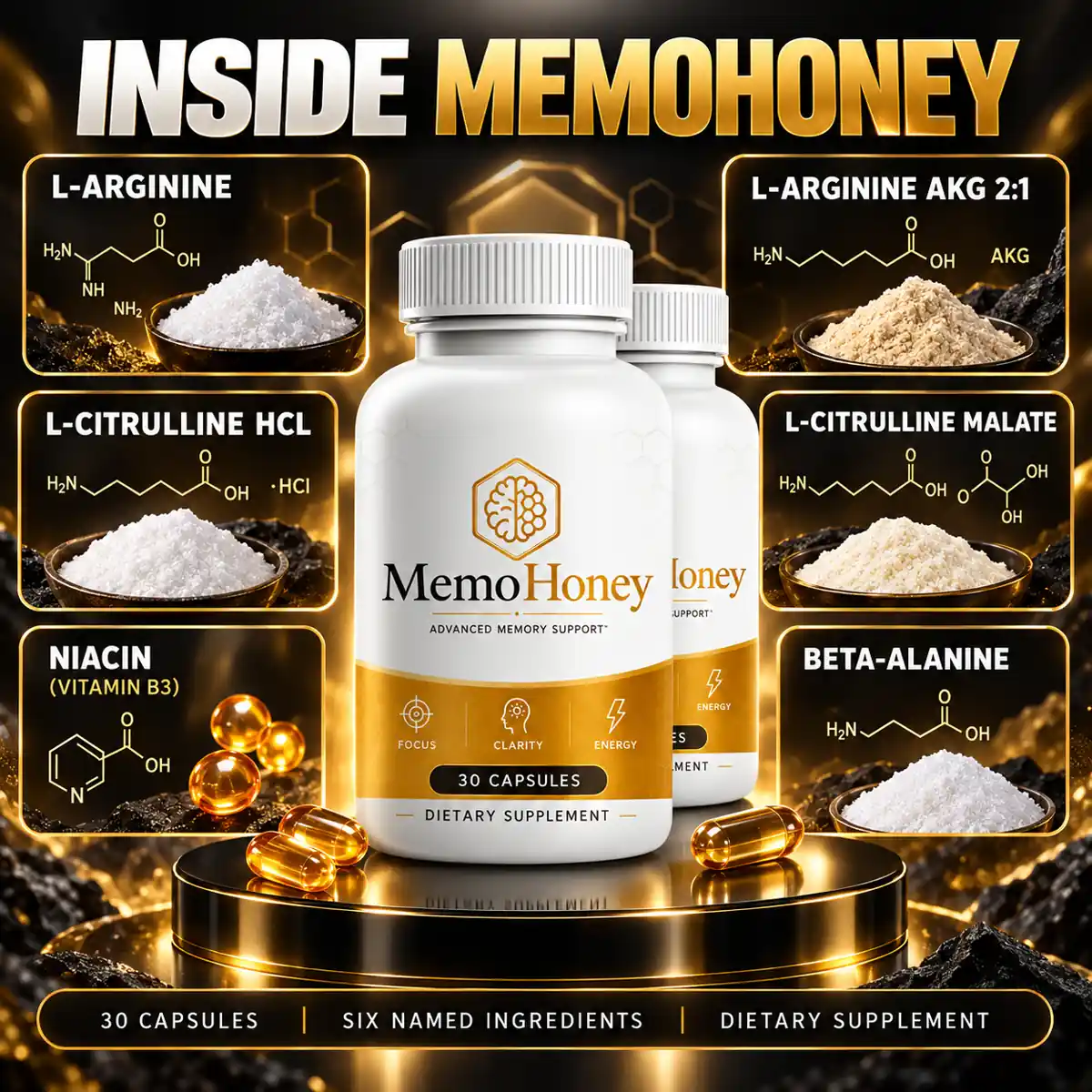
MemoHoney research means research on its ingredients, because no published trial has tested the MemoHoney capsule itself. Four of its six named actives, two forms of arginine and two of citrulline, feed the nitric oxide pathway, and that blood-flow mechanism is real. The gap is at the last step: nobody has shown that swallowing a nitric oxide precursor changes what you remember. This article sets out both halves.
The mechanism that is genuinely established
When a region of your cortex becomes active, the small vessels feeding it widen within a second or two and local blood flow rises to meet the demand. The phenomenon is called neurovascular coupling, and it is not a supplement-industry idea: it is the basis of every functional brain scan ever published. The signal those scanners read is the blood-flow response, not the neural activity itself.
Nitric oxide is one of the messengers that carries it. A 2021 review lays out the nitric oxide pathways involved, how they degrade under stress and with age, and what would be needed to rescue them. Separate work on astrocytes describes how those cells use nitric-oxide-dependent calcium signalling to regulate the same coupling.
There is also a downstream observation that makes the subject more than academic. A study of cognitively normal older adults found that cerebral blood flow and amyloid burden interacted to affect memory performance, in people with no diagnosis at all. Perfusion is not a sideshow in this field.
Which is why the premise is not silly
A formula that says blood flow matters for thinking is saying something true. That is worth stating plainly, because the reflexive dismissal of supplement marketing sometimes throws out a correct premise along with an unsupported conclusion. The premise here is correct. What follows from it is the problem.
Why labels carry citrulline as well as arginine
If you only ever learn one thing about this ingredient family, make it this one, because it explains a label that otherwise looks redundant.
Arginine is the direct substrate for nitric oxide synthase. Swallowing arginine ought therefore to be the obvious move, and it mostly is not. Arginase in the intestinal wall and the liver breaks down a large fraction of an oral dose before it reaches circulation, which is why arginine trials reach for gram-scale amounts and still produce inconsistent results.
Citrulline takes a different road. It is absorbed largely intact, bypasses that first-pass metabolism, and is converted back into arginine by the kidney. The dose-ranging study measured exactly this in healthy volunteers, running a ladder from 0.75 g to 6 g and comparing it against oral arginine. Citrulline raised plasma arginine more effectively than arginine did, and the rise tracked the dose.
Listing both, then, is not filler. It is a formulation choice with a real study behind it, and on the formula this website sells it is the single strongest piece of reasoning available.
- Nitric oxide is made from arginine by nitric oxide synthase.
- Oral arginine is largely destroyed before it reaches the bloodstream.
- Oral citrulline survives that and the kidney converts it to arginine.
- Nitric oxide widens small vessels, including in the brain.
- Local blood flow rising to meet neural activity is how brain scanners work.
Where the chain breaks
Laid out as a chain, the argument looks strong until the last link.
| Step in the chain | How well established | What was measured |
|---|---|---|
| Citrulline raises plasma arginine | Well established | Plasma arginine concentrations across a dose ladder |
| Arginine is the substrate for nitric oxide synthase | Textbook biochemistry | Enzyme kinetics, not a supplement outcome |
| Nitric oxide participates in neurovascular coupling | Well established | Vessel diameter and local flow in response to neural activity |
| Cerebral blood flow relates to memory performance | Observed in older adults | Perfusion imaging against memory scores |
| A capsule of precursor improves recall | Not demonstrated | No trial of this chain has been published |
Four links hold. The fifth is the one a buyer cares about and it is the one nobody has tested.
The first four links are supported by literature you can read. The fifth is where a product page usually puts a confident sentence and where this one puts a gap.
It matters that the gap is at the end rather than the beginning. A formula built on a false premise is easy to dismiss. A formula built on a true premise whose final step has never been tested is a genuinely open question, and open questions are worth sixty days of your own attention in a way that nonsense is not.
Test the open question yourself with MemoHoney
Sixty days is the window, and it is long enough to run the eight-week test properly. Two bottles covers exactly that.
Two bottles $158 · six bottles $294 · 60-day money-back guarantee
Order MemoHoney On The Official WebsiteOne capsule a day · 30 per bottle · lot MEM-26/ME-3415
What the precursor trials measured instead
This is the table that settles most arguments about this ingredient family, because it shows what the researchers were actually interested in.
| Ingredient | Representative study | Endpoint measured |
|---|---|---|
| L-citrulline | Dose-ranging pharmacology, 2008 | Plasma arginine and nitric oxide metabolites |
| L-arginine | VINTAGE MI, 2006 | Vascular stiffness and clinical outcomes |
| Arginine silicate | Randomised trial, 2021 | Acute cognitive outcomes in healthy adults, using a patented complex |
| Citrulline malate | Bench press trial, 2010 | Repetitions and muscle soreness |
| Citrulline malate | Sprint trial, 2024 | Repeated sprint running performance |
One of these five measured cognition, and it used a different molecule from the plain arginine on most labels in this family.
Plasma chemistry, vascular stiffness, bench press repetitions, sprint times. These are sports-nutrition and cardiovascular endpoints, published in sports-nutrition and cardiovascular journals, and they are the research base these ingredients bring with them onto a memory label.
There is one exception in that table and it deserves care. A 2021 randomised trial did report acute cognitive outcomes in healthy adults, and it used inositol-stabilised arginine silicate: a patented complex, not the plain L-arginine most labels carry. Citing it as evidence for plain arginine would be the kind of substitution this desk checks for.
And one study in that list is a warning rather than a finding. the VINTAGE MI trial gave 9 g of arginine a day to people recovering from a heart attack and was stopped early after six deaths in the arginine arm and none on placebo. That is a gram-scale dose in a fragile population and it says nothing about a capsule. It says a great deal about why the dose question in this family is worth asking.
The one pattern worth noticing
Where these ingredients have shown anything cognitive, the participants were older.
The trial in the carnosine family that reported an effect on verbal episodic memory recruited elderly participants. The beta-alanine trial that reported cognitive and mood effects recruited 60 to 80 year olds. The chronic citrulline work on vascular function was run in older individuals specifically, because vascular function is where age makes the largest difference.
Meanwhile the one randomised cognitive test of beta-alanine in young, healthy adults, in elite soldiers averaging twenty years old, found no difference at all.
None of that establishes anything about a particular capsule at an unstated dose. It does suggest that if a blood-flow formula is going to do anything for anyone, the someone is more likely to be sixty than twenty-five, and the who it is for page says so at product level.
Why that pattern is not a marketing convenience
It would be easy to read the age split as a way of explaining away a negative result, so it is worth saying why it is not. The mechanism predicts it in advance. Neurovascular coupling degrades with age, tissue carnosine falls with age, and a twenty-year-old in elite physical condition has neither deficit to correct. A supplement that tops up something already sufficient has nothing to act on, and finding nothing in that population is the result the biology would forecast rather than a rescue applied afterwards. The same logic predicts that any effect at all should be small, slow and hardest to detect in exactly the people most likely to be reading about it.
How to read a blood-flow label
Four questions sort this shelf quickly, and none of them requires a biochemistry degree.
- Is citrulline present, or only arginine? Arginine alone is the weaker construction, for the first-pass reason above.
- Is there an amount printed? The trial doses here run from grams upward. Without a figure you cannot compare anything with anything.
- What endpoint is the marketing implying? If it implies memory, ask which trial measured memory. Usually none did.
- Does the caution name blood pressure medicine? A nitric oxide formula that does not mention it was written without thinking about the mechanism.
On the label this website sells, the answers are: yes to citrulline in two forms, no amount for any of the six, memory implied by the bottle line, and yes, the caution names blood pressure medicine, blood thinners and vasodilators. The ingredients page works through all six names with the trial dose beside each.
MemoHoney is a dietary supplement for healthy adults of 18 and over. It is not a medicine, it is not FDA-approved, and it is not intended to diagnose, treat, cure or prevent any disease. Memory that is getting worse month by month, or that family notice before you do, deserves an assessment: thyroid function, vitamin B12, depression, sleep apnoea, hearing loss and several common medicines all produce the same symptom and all have a route to treatment that a capsule does not.
References
- From Front Physiol (2021): Nitric Oxide Pathways in Neurovascular Coupling Under Normal and Stress Conditions in the Brain: Strategies to Rescue Aberrant Coupling and Improve Cerebral Blood Flow, by Lourenço with co-authors; PubMed ID 34744769. https://pubmed.ncbi.nlm.nih.gov/34744769/
- From Front Cell Neurosci (2015): Control of the neurovascular coupling by nitric oxide-dependent regulation of astrocytic Ca(2+) signaling, by Muñoz with co-authors; PubMed ID 25805969. https://pubmed.ncbi.nlm.nih.gov/25805969/
- From Front Aging Neurosci (2017): Cerebral Blood Flow and Amyloid-β Interact to Affect Memory Performance in Cognitively Normal Older Adults, by Bangen with co-authors; PubMed ID 28642699. https://pubmed.ncbi.nlm.nih.gov/28642699/
- From Br J Clin Pharmacol (2008): Pharmacokinetic and pharmacodynamic properties of oral L-citrulline and L-arginine: impact on nitric oxide metabolism, by Schwedhelm with co-authors; PubMed ID 17662090. https://pubmed.ncbi.nlm.nih.gov/17662090/
- From JAMA (2006): L-arginine therapy in acute myocardial infarction: the Vascular Interaction With Age in Myocardial Infarction (VINTAGE MI) randomized clinical trial, by Schulman with co-authors; PubMed ID 16391217. https://pubmed.ncbi.nlm.nih.gov/16391217/
- From Nutrients (2021): Acute Inositol-Stabilized Arginine Silicate Improves Cognitive Outcomes in Healthy Adults, by Gills with co-authors; PubMed ID 34959823. https://pubmed.ncbi.nlm.nih.gov/34959823/